


Year 9 Options
At Key Stage 4, students follow personalised learning programmes where they can choose from a range of courses carefully selected to match their learning needs and maximise their achievement and fulfilment in these important years.
Dear Year 9 Student,
You are now embarking on one of the most important decisions of your educational career. Making sure you pick the Key Stage 4 courses that are right for you will make a big difference in the next two years and beyond.
Getting it right will help you to finish Year 11 with a great set of GCSE results; getting it wrong will put that at risk. It may affect whether you are able to attend university. It might also mean the difference between securing the future job of your dreams or having to settle for something less than you want. So, it is important, and you should treat it as such.
The information on this page sets out the decision-making process and provides you with some of the advice you will need in order to get it right.
I very much look forward to supporting you with this process and the next exciting chapter in your life at Preston Manor.
Mr D Tully
Deputy Headteacher
CLICK HERE to view the Year 9 section of our website
Core Subjects
This is the core curriculum made up of compulsory subjects that students must study:
| English Language |
English Literature |
Mathematics | Sciences | Physical Education | PSHE |
| 1 GCSE | 1 GCSE | 1 GCSE | 2/3 GCSE | - | - |
English: GCSE English language and GCSE English Literature.
Mathematics: GCSE in mathematics.
Science: The science department offers a range of qualifications tailored to meet individual student needs. This includes separate science and combined Science.
Physical Education: All students complete two hours of compulsory GCSE Physical Education every week. Some students will go onto to study GCSE Physical Education as part of their Option Choices.
*PSHE: This is delivered for 1 hour per week on a rolling programme.
Option Blocks
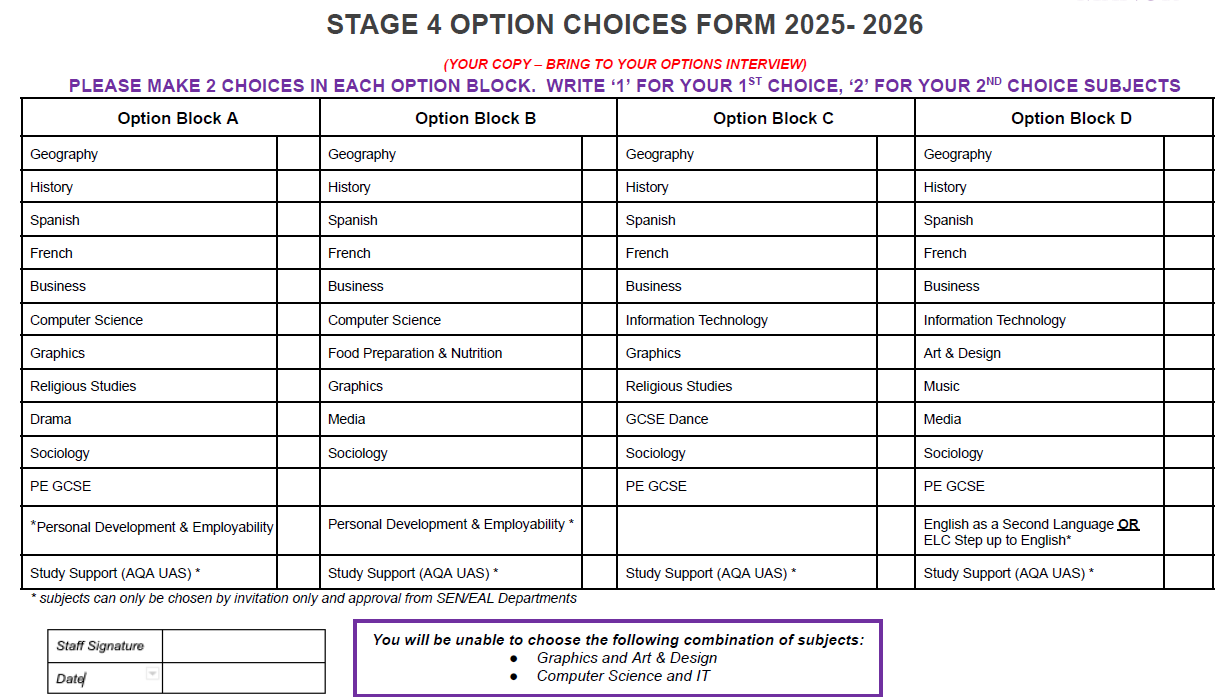
In terms of practicalities, you must choose subjects from each box. Please choose two possibilities in each option box, writing 1 beside your first choice and 2 beside your reserve choice. We shall try our best to give you your first choice, but this cannot be guaranteed, which is why it is important for you to choose a reserve in each block.
For subjects with an ‘*’ next to them, teachers may have suggested you study this course because it would be of great benefit to you.
Some combinations of subjects are not allowed due to being similar in content. These are:
- Art & Design and Graphics
- IT and Computer Science
| Option A | Option B | Option C | Option D |
| Geography | Geography | Geography | Geography |
| History | History | History | History |
| Spanish | Spanish | Spanish | Spanish |
| French | French | French | French |
| Business | Business | Business | Business |
| Computer Science | Computer Science | Information Technology | Information Technology |
| Graphics | Food Preparation & Nutrition | Art & Design | Art & Design |
| Religious Studies | Graphics | Religious Studies | Music |
| Drama | Media | Dance GCSE | Media |
| Sociology | Sociology | Sociology | Sociology |
| PE GCSE | PE GCSE | PE GCSE | |
| Personal Development & Employability * | Personal Development & Employability * | English as a Second Language OR English as an Additional Language |
|
| Study Support (AQA UAS) * | Study Support (AQA UAS) * | Study Support (AQA UAS) * | Study Support (AQA UAS) * |
A form is at the end of the attached booklet.
If you can speak and write in another language, then you may have the opportunity to take an extra qualification in this language. Any students choosing to do this must be prepared to use their own time, outside of school hours, to prepare for this.
The school will try to support this by entering you for the qualification and will provide you with examination papers to practise with. For groups of more than 10, the school may be able to offer after-school sessions throughout the year to support their studies. Please discuss with Mr Lipinski if you have any questions.
Please use the expandable sections below to find out more.
Steps to Successful Choices
You will be able to choose from a wide range of courses and qualifications. You will need to choose your courses wisely depending on your interests, strengths and your aspirations beyond Year 11.
STEP 1: Attend Options Evening on Wednesday 4th February at 5.00pm.
Ensure that the courses you choose are:
- Subjects you are interested in and those that fit with your future plans.
- Subjects you enjoy and will keep your attention for two years.
- Subjects you are being successful in (if you are studying them in Years 7-9). Use your latest. Progress Report to check the subjects you are being successful in.
STEP 2: Read about the different courses in this booklet and decide which ones best suit you by:
- Look at the topics covered. Does this interest you?
- Check what you can go on and study in the future. Might this be something you want to do?
- Look at the type of courses on offer BTEC, OCR National and GCSE, and consider the different assessments of these courses and which will suit you best.
STEP 3: Speak to your teacher and ask questions about the course. Speak with older students about their experience of the course, but remember this is only their view, NOT yours!
STEP 4: Complete the Options Form and bring it in for your Options Interview.
DO NOT CHOOSE A SUBJECT FOR THE FOLLOWING REASONS:
- You like the teacher
- Your friends are taking that subject.
- You feel the subject is easier than others (all subjects are equally challenging).
- A member of your family studied it.
Useful Websites to help make your choices
- iCloud
Brings together helpful advice about choosing GCSE options. https://icould.com/stories/choosing-your-gcse-options/
- UCAS
Find out about universities and the course they can offer. You can also find out what subjects you need to have in order to get on their courses. If you know what qualifications you need at 18 years old, you can then work out what subjects you will need at the end of Year 11 when you are16 years old.
www.ucas.com
Frequently Asked Questions
Once I make my selection, am I guaranteed my option choices?
No. We shall, of course, try our best to get you your first choice subjects however this may not be possible. If not enough students choose to do a subject, it may have close down and your reserve choice will be selected. If this happens, you and your family will be informed by the school.
What if I do not get my first choices?
Your reserve choice will then be selected. This is why you must pick a reserve choice in each block.
What are English Baccalaureate subjects?
An English Baccalaureate is not a qualification. It is a term used to describe a number of GCSE subjects that the government considers to be highly valued. Top tier Universities desire this in order to apply due to the breadth of curriculum that it results in. Subjects include English, Maths, Science (including Biology, Chemistry, Physics), History, Geography, Computer Science, French and Spanish. The government is encouraging the study of 5 of these subjects (English, Maths, Science are compulsory, either History or Geography, either French or Spanish. Computer Science is an additional if desired).
What if I do not know what I want to do in the future?
Keep your options open. Keep in mind that you might want to go to university or that you might want to do an apprenticeship etc. Select a range of subjects from across the curriculum, e.g. a language, a humanities subject (History or Geography), an arts subject (Art, Graphics, Drama, Music) and one other subject such as PE, RS, Food, etc. Include in your selection what you are being successful in and what you enjoy doing, after all you are more likely to study harder in these subjects. Finally, you may wish to pick a subject that is more practical than others that are 100% written exam. Subjects like Art, Graphics, IT, PE, Food and Media have assignments which are worth marks towards your final grade, which you must complete before your examination.
Do I need to be able to read music or play an instrument to choose GCSE Music?
Being able to read music would be an advantage, although the course will teach you this. You do, however, have to be prepared to study an instrument as part of your course. You can select which instrument, which could be your voice, if you would like to sing. To develop your skills to the appropriate standard for the course, you will be required to attend additional peripatetic lessons.
I am struggling to choose which subjects to select. What do I do?
You are not alone. Speak to others to get their support. Speak to your teachers about whether you would be suited to their subject. Speak with your parents / carers, they know you well! Speak to students in the older year groups about the courses they study. You can also speak with your form tutor and our careers advisor.
What are the differences between BTEC, OCR Cambridge National and GCSE?
Each of these types of qualification are equally as challenging and are of equal value to sixth forms, colleges and employers. The differences are about the way they are assessed. GCSEs are 100% exams that are taken at the end of Year 11. BTECs and OCR Cambridge Nationals have assignments throughout the two years that earn you marks towards your final grade. You still sit an exam in Year 11. This is ideal for students who may not perform at their best in exams.
Can I change my options once I have chosen them?
You need to ensure that you are making your choices carefully, and research each subject carefully. Your options will be chosen in a one-to-one interview after the February half-term. After this, it is extremely difficult to change your choices and this will only occur in extraordinary circumstances.
Subject Information
Please CLICK HERE to view more information about each subject on offer.